Showing posts with label Archives. Show all posts

Thursday, December 7, 2017

#TBT in the Archives 12/7/17: End of semester studies

With the fall semester coming to a close, most students (graduate and undergraduate) are frantically completing term papers, preparing for exams, and presenting final projects. In the midst of all this, everyone is doing the same thing - stressing out!

Studying, projects and stress are a normal part of the college experience - even at Shippensburg. And though current students have the benefit of the internet, group chats, and other web tools to complete their projects and help them along, students of the past also found ways to efficiently complete the semester.

Of course, one's dorm room has always been a favorite place to study, even though friends and roommates might be distracting.

A Shippensburg student studies in his room during the 1952-1951 academic year.


Another student and a friend (hidden behind the newspaper at right) take time to catch up on the news in 1952.

When the weather allows, campus lawns offer a relaxing place to meet with friends and catch up with work. Though the weather is currently a bit cold for students to enjoy that study method, spring temperatures will return in a few months.

Springtime studies outdoors.
Students study outside the library in 1989.

In 1977 the Department of Academic Services published a helpful booklet called Your Study Skills or ... The Care and Feeding of Your Grade Point Average. Available at the time at the college bookstore or by visiting the department, the booklet written by campus administrators offered helpful tips on taking notes, preparing for tests, completing research papers, and other crucial parts of completing college.

These suggestions for test anxiety shared in 1977's Your Study Skills or... The Care and Feeding of Your Grade Point Average still have useful advice for students in 2017: Get enough sleep, put things in perspective, get organized, and take a deep breath.
Though some of these 1977 suggestions about the library might be outdated (tapes, cassettes and filmstrips?) the Ezra Lehman Library remains a favorite resource for stressed Shippensburg students.
Students in the reference section of the library in 1977.

As computers became increasingly useful to students in the late 1980s and early 1990s, computer labs were available across campus for various applications including preparing typed final term papers. Today, computer labs and laptops available at the library's circulation desk continue to be vital tools for students.

Computers sure looked different in the 1990s! But the looks of concentration worn by these students certainly seem familiar!

Though study tools and hairstyles may have changed, Shippensburg students continue to face the end of each semester bravely, completing tests and papers despite the stress. Shippensburg University Archives & Special Collections has lots of images and yearbooks depicting study sessions of the past as well as a copy of Your Study Skills or... The Care and Feeding of Your Grade Point Average. To look at these, make an appointment to visit by emailing specialcollections@ship.edu.

Are you feeling stressed as you study and prepare for finals? A variety of resources are available to help you succeed! Librarians are able to help you navigate library resources and databases and figure out citations. Plus, the Learning Center on the main floor of the library (http://learning.ship.edu/home) can help with writing coaching and content tutoring. Don't forget to take a break from all of your hard work -- visit Lehman Library's galleries to enjoy fun "Winter Stress & Decompress" activities such as cutting out paper snowflakes, doing puzzles, and coloring. Good luck!


Sources
Barbara Crist and Len Czarnecki, Your Study Skills or ... The Care and Feeding of Your Grade Point Average (Shippensburg: Shippensburg Collegiate Press, 1977).
Cumberland 1952 (Shippensburg, PA: Shippensburg State Teachers College, 1952).
Cumberland 1970, (Shippensburg, PA: Shippensburg State College, 1970).
Photographs, Record Group 30, Shippensburg University Archives & Special Collections, Shippensburg, PA.

Thursday, November 16, 2017

#TBT in the Archives 11/16/17: Thanksgiving

Turkey Day is just around the corner! As Shippensburg students get ready to take a few days off, see family, eat delicious meals, and give thanks, we thought it would be fun to explore past Thanksgiving celebrations on campus.

Students attending Cumberland Valley State Normal School in the early 20th century liked to save napkins from special dinners and events on campus. Several in the archives are from trips to Washington D.C., and others are connected to dinners and dances. The person who saved the napkins often wrote the date of the event and the occasion, and in some cases, had their friends sign. A Thanksgiving napkin at the archives is decorated with cherries and greenery and is dated 1906.

A napkin from the 1906 Thanksgiving dinner.

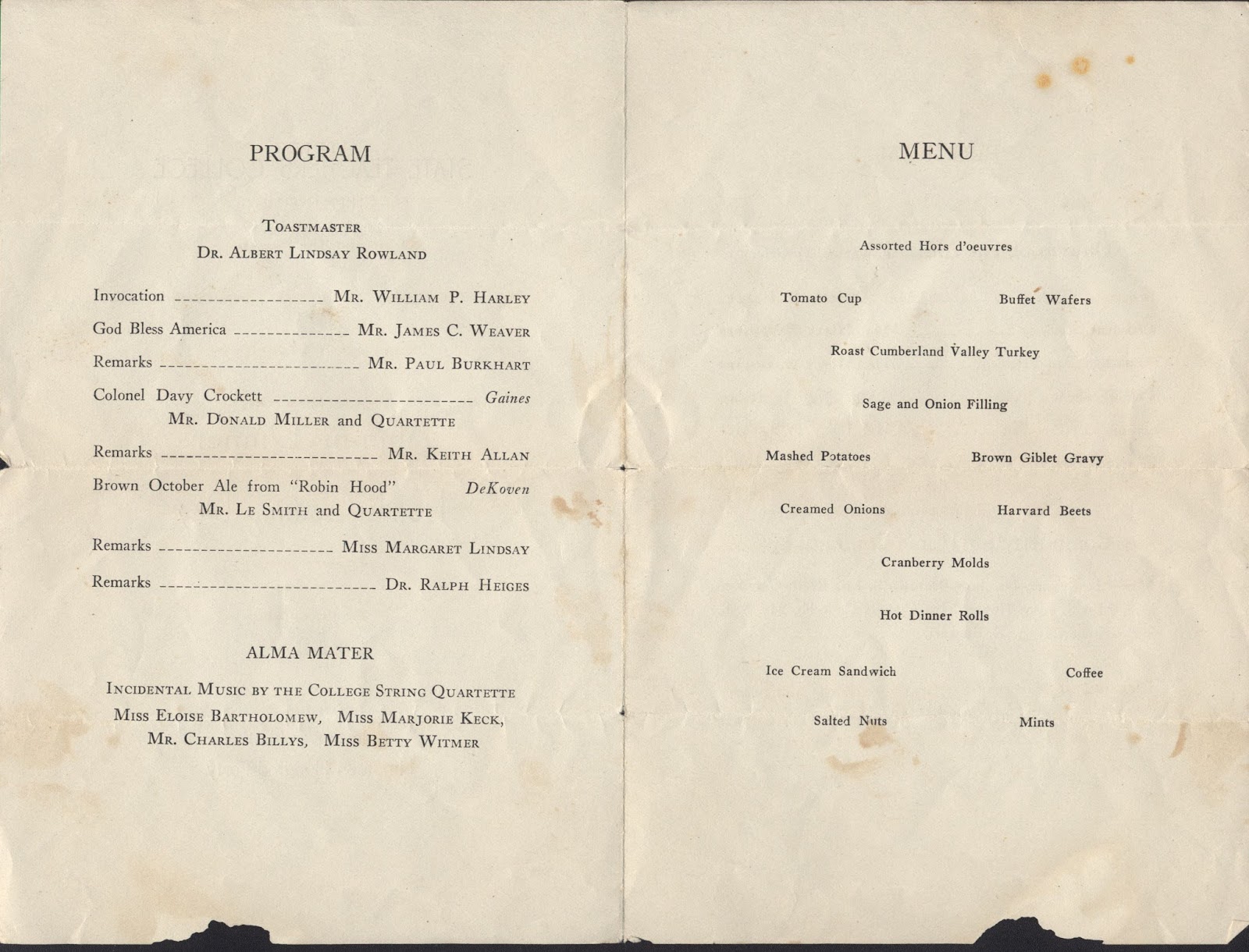
Much like today, the campus came together at the end of each November to enjoy a formal Thanksgiving meal. Though turkey and gravy were always on the menu, the vegetables and pies offered each year tended to change.

Mashed potatoes, celery, creamed onions and candied sweet potatoes were the side dishes in 1922. The meal closed with a mince pie a la mode. "Saratoga Flakes," listed next to the salad, is a type of frosted flake cereal.
Ten students signed this Thanksgiving menu from 1923.  Some side dishes disappeared this year, and the dessert was apple pie with ice cream. 
Dessert changed again to peach pie in 1924, and sweet potatoes returned to the menu. Also offered were buttered peas.
The economic turmoil of the 1930s meant the 1931 Thanksgiving menu was not printed in an ornate pamphlet. However, students still ate their fill of traditional Thanksgiving dishes, including buttered carrots, and pumpkin custard pie a la mode.

Not only did Thanksgiving mean food and friends, but Shippensburg students also celebrated with football games and theater. In 1924, Shippensburg battled Slippery Rock on the gridiron, and students could watch for just 50 cents.

1924 football ticket.

Dramatic plays were also on the menu, with students playing starring roles.

 A cast photo for "Stop Thief," performed November 27, 1919.
The cast of "Green Stockings," presented in November 1921.

Whether it be football, theater, or food, Shippensburg students have always made the most of the Thanksgiving holiday. What are your plans for Thanksgiving 2017?


Sources:
Class Files, Shippensburg University Archives & Special Collections, Shippensburg, PA.
Oversize photographs, Record Group 31, Shippensburg University Archives & Special Collections, Shippensburg, PA.
Photographs, Record Group 30, Shippensburg University Archives & Special Collections, Shippensburg, PA.


Thursday, November 9, 2017

#TBT in the Archives 11/9/2017: Pennsylvania Museum Extension Project

As part of Franklin D. Roosevelt's New Deal during the Great Depression, the Works Progress Administration (WPA) put millions of people to work throughout the United States. In Pennsylvania, the WPA's most ambitious project involved arts and education in the form of the Pennsylvania Museum Extension Project (MEP).

Based in Harrisburg with workshops located across the state, the Museum Extension Project was the first of its kind in the nation when it launched in 1935. It ended up producing millions of models, art pieces, illustrations, dioramas, and more for use by educators in public schools across the state.

A display case containing 24 varieties of crop seeds showed students the first step in growing food.

With training educators as its main mission during the Great Depression, Shippensburg State Teachers College had a model elementary training school on campus attended by local primary school students. Thanks to the Museum Extension Project, the model school and future teachers had the use of a wide variety of models, dioramas and lantern slides to teach history and science.

These materials now reside at Shippensburg University Archives & Special Collections, and many of the dioramas are on display on the main floor in the Learning Center.

A scale model of Eli Whitney's cotton gin connected students to the spark of the industrial revolution.

Museum Extension Program leaders tried to locate workshops in communities where skilled artisans resided. For example, a workshop in Lancaster County produced scale models of furniture and related items. Some of these models are in Shippensburg's collection.

This tiny printing press only occupies approximately six square inches, but offers a detailed view of a crucial piece of early technology.

By 1939, project staffers began working with the Pennsylvania Historical Commission (later the Pennsylvania Historical and Museum Commission) to document historic sites, houses, and other structures. As a part of this relationship, the MEP began producing dioramas of these sites. Many are in the Shippensburg collection.

A model of a pueblo village.
Dioramas depicting industry, like this oil well, showed students industry close to home.

Still other products of the MEP included lantern slides, which could be used by teachers to show students models and dioramas that did not physically exist in the collection. Dozens of lantern slides at Shippensburg show classical and indigenous dwellings. Other lantern slides include plates showing the traditional costumes of native peoples of the Americas and Asia.

Dioramas and models are on display in Ezra Lehman Memorial Library anytime the library is open. To check out the lantern slides and accompanying description, make an appointment by emailing specialcollections@ship.edu.

Sources:
Curtis Miner, "Art With a Purpose: Pennsylvania's Museum Extension Project, 1935-1943," in Pennsylvania Heritage (Spring 2008), accessed November 7, 2017, http://www.phmc.state.pa.us/portal/communities/pa-heritage/art-with-purpose-pennsylvania-museum-extension-project-1935-1943.html
Pennsylvania Museum Extension Project Collection, Shippensburg University Archives & Special Collections, Shippensburg, PA.

Thursday, November 2, 2017

#TBT in the Archives 11/2/17: Books on Exhibit

As the weather gets colder, there's nothing more comforting than curling up with a good book and some hot tea - no matter your age!

Shippensburg State College librarians in the 1950s definitely believed everything is better with a book, and launched a program to put Cumberland County teachers and school librarians in touch with the latest "junior library books" available for young readers.

Launched in 1957, "Books on Exhibit" was a traveling collection of books that toured the county during the academic year to make it easy for teachers to choose new titles for their students. The exhibit opened at the beginning of November at Ezra Lehman Memorial Library.

The 1957 Books on Exhibit launched in early November.

In 1958, "Books on Exhibit" dominated the downstairs of the library (then located in Huber). Children from the campus laboratory school were welcome to peruse the new selections.

Books like Rockets, Satellites, and Space Travel were among the books that caught these boys' attention.

The Cat in the Hat Comes Back, as read by the girl in the foreground, was a new book for 1958.


Books for all levels of young readers were displayed.


Teachers from Shippensburg schools as well as aspiring teachers attending Shippensburg State College also wandered the exhibit.

Teachers share Books on Exhibit finds with one another.

There was something for every classroom library on display.

The exhibit continued for several years and could be scheduled to visit any Cumberland County school by contacting librarians at Ezra Lehman Memorial Library. 

The new Library Science program was announced in the same 1959 edition of The Slate as "Books on Exhibit."

Sources:
Books on Exhibit, 1958, Photographs, Record Group 30, Series 4, Box 1, Shippensburg University Archives & Special Collections, Shippensburg, PA.
The Slate, Shippensburg, PA


Thursday, October 26, 2017

#TBT in the Archives 10/26/17: Historic homecomings

Another Shippensburg University homecoming passed into history last weekend as thousands of Shippensburg alumni returned to campus to watch the Raiders best Millersville 51-14 as well as parade through town, reconnect with friends, and crown this year's king and queen. As you recover from the weekend's festivities, we thought it would be fun to revisit past homecomings this week.

Homecoming has been an annual tradition at Shippensburg since 1925. The first game was held October 31 when the Shippensburg Normal football team faced off against West Chester. Alumni were invited to attend the festivities, and the program featured details and photos of the team and coach.

1925 homecoming program

By 1930, homecoming had turned into a beloved campus event, alumni were issued tickets, and the Varsity Club issued tags emblazoned with the letter "S" to enable spectators to clearly display their allegiance.

Game ticket, November 15, 1930

Varsity Club homecoming tag from the fall of 1930.

In the 1930s, homecoming was the main time alumni returned to campus, and as a result, events took on the theme of reunion. A highlight of the weekend was a dinner held by the college president after the game, which was attended by alumni. Current students attended a school dance after the game.

1930 homecoming menu

The 1930 homecoming dinner featured roasted turkey and stuffing as well as the "Alumni Special" Salad, which contained cheese wafers and Russian dressing among other mystery ingredients. The dinner tradition continued in 1940 with nearly the same menu. Roasted turkey was likely an alumni favorite.

1940 homecoming menu

The 1940 homecoming dinner also included musical entertainment and speeches.

Homecoming has continued to be a popular Ship tradition. In 1992, President Anthony Ceddia and his wife enjoyed riding through the homecoming parade in an antique automobile.

President Ceddia took part in the 1992 homecoming parade

The 2002 homecoming game was rainy, but that didn't stop a full house at Grove Stadium or an "American Idol" competition in the CUB that weekend.

The 2002 homecoming game was reviewed in the 2003 Cumberland yearbook.

And in 2014, the yearbook dedicated several pages to the homecoming court, marching band, and other highlights, not to mention the football game itself!

The 2013 homecoming king and queen (top picture) celebrated with the new king and queen (bottom picture) in 2014.

Homecoming continues to be a great day to make memories at Ship! We hope everyone had a great time last weekend.


Sources:
Class Files, 1925, 1930, 1931, and 1941, Shippensburg University Archives & Special Collections, Shippensburg, PA.
Cumberland 1993, Shippensburg, PA.
Cumberland 2003, Shippensburg, PA.
Cumberland 2015, Shippensburg, PA.


Thursday, October 12, 2017

#TBT in the Archives 10/12/17: Chapel services

School Chapel Services

Before email and campus alert systems, how did faculty and staff share important information with the entire student body? Sometimes, the easiest way to share information is through a meeting. Early Shippensburg students were required to go to chapel services daily, then later weekly, in order to both participate in religious activities, and hear updates and announcements.

In addition, students at Shippensburg until the 1930s did not have the flexibility to choose whether or not to attend church, let alone practice a non-Christian faith, and were required to attend weekly religious services in addition to the daily chapel services, or face academic troubles.

This page from the 1889-1890 Cumberland Valley State Normal School catalog says students were required to attend a church of their choice weekly in Shippensburg.

Students in the late 1880s were required to attend church services in Shippensburg weekly, unless they were excused by the principal. Additionally, Sunday school was organized each week, and prayer meetings were held each Wednesday night. Those activities were voluntary, but students were  required in the 1890s to attend chapel services each morning at 8:45 a.m.

By 1897, the Y.M.C.A. and the Y.W.C.A were on campus and met weekly to discuss topics of interest to Christians and hold Bible studies.

In 1916-1917, the student handbook published a list of Shippensburg churches. The practice continued for decades.


Through the early 1930s, chapel attendance and weekly church attendance continued to be required of students. Failure to attend could hurt one's academic standing as faculty kept track of attendance.

Mr. Buckalow was issued a warning in 1913 when he failed to attend church regularly.

Chapel meetings were used for communication, but also involved faith-based activities. In 1927, daily meetings were abolished and instead, attendance was expected Tuesdays and Thursdays. Additionally, the time became later in the morning each year.


The school issued schedules each semester with chapel activities to expect:

The fall 1931 chapel schedule.

The spring 1942 chapel schedule
The fall 1945 chapel schedule. By this time, meetings were held weekly.

By the 1933-34 academic year, the school abolished the requirement to attend church services in Shippensburg each week though it was still strongly suggested. As the school's identity as a state institution deepened in the early decades of the 20th century, the school moved farther away from requiring religious practice.

However, as late as 1960, the student catalog continued to urge attendance at weekly services in Shippensburg. In addition to publishing a list of churches in the student handbook, a number of campus religious groups were listed accommodating students of a variety of Christian traditions.

Today Shippensburg University experiences a vibrant faith community with beliefs and non-beliefs of all kinds represented across the student body, in formal campus ministry activities, and student-run clubs and organizations. Students in 2017 are fortunate their participation does not affect their academic standing!


Sources
Catalogs, 1889-1890, 1897-1898, 1927-1928, 1933-1934,1934-1935, 1960-1961. Shippensburg, PA: Cumberland Valley Normal School and Shippensburg State Teachers College.
Class files, 1913, 1931, 1942 and 1946. Shippensburg University Archives & Special Collections, Shippensburg, PA.
Student handbook, 1916-1917, 1960-1961 Shippensburg, PA: Cumberland Valley State Normal School, 1916.

Thursday, October 5, 2017

#TBT in the Archives 10/5/17: Battle of the Sexes

In the early 1970s, many movements for social change launched in the late 1960s continued. From racial equality to feminism, people across the country were determined to make changes for the better. Shippensburg State College was no exception, and students regularly participated in rallies, petition drives, and demonstrations to share their opinions with state representatives, school officials, and each other.

An event during the fall semester of 1973 was one of these demonstrations. Unlike the others, it was unplanned, and in the end, it took a decidedly fun tone.

Female tennis superstar Billie Jean King took on male player Bobby Riggs in a tennis match billed "The Battle of the Sexes" on September, 20, 1973. Prior to the match, Riggs relied on his role as a male tennis player to overhype his ability to best any woman on the tennis court, no matter her record. King easily beat him in a three-match victory that was not only a sports win, but a victory for many American women.


The September 25, 1973 Slate reported on the aftermath of the Battle of the Sexes tennis match in Shippensburg.

According to the September 25, 1973 Slate, King's victory was announced in Naugle Hall (the women's dorm). The women then called to the men's dorm, Mowrey Hall, and asked a similar announcement be made. After they were refused, 12 women walked to Mowery Hall singing "I Am Woman," where they were greeted by the male residents with firecrackers and buckets of water thrown out windows.

After the women retreated, they were followed by firecracker-wielding men who attempted to capture a large sign hanging from the third floor of Naugle Hall which said "We Love You, Billie Jean." During the uproar, women threw buckets of water out the windows and blasted "I Am Woman" from speakers. At one point, the women called reinforcements from McLean Hall as the men continued to work to capture the sign. The clash dispersed after the Dean of Men got involved.

Photos of the Battle of the Sexes "clash" at Shippensburg State College published in the September 25th Slate.

The clash ended up being an episode of campus revelry, but for Shippensburg women, King's victory over Riggs boosted spirits.


Team photos and records for 1973-74 as published in the Cumberland in 1974.

Tennis at Shippensburg was generally boosted in the wake of the King-Riggs matches. Men's and women's tennis were both competitive at the state level during the 1973-1974 school year, though neither team had a fabulous record.


Sources:
The Slate, Shippensburg, PA, September 25, 1973.
Cumberland 1974, Shippensburg, PA.


Thursday, September 28, 2017

#TBT in the Archives 9/28/17: World War I

In April 1916 after it became clear a policy of non-intervention was no longer possible, the United States declared war against Germany, entering what was then known as the Great War. Men and women across the nation mobilized in support of the nation's war effort, and the Cumberland Valley State Normal School was no exception.

Most young men entering the armed services were conscripted, though certainly a large number enlisted by choice. In October 1917, Principal Ezra Lehman reported 25 to 30 male students had been conscripted since the last school year. Additionally, several women had been pulled out of school by their local school districts to begin teaching before finishing their own studies - a move made necessary by the conscription of male teachers. Other women had not returned to school because of the need to make money for their families after the departure of men.

Additionally, football prospects for the 1917-1918 season looked dim because of a lack of players.

Not all was bad, according to the Normal School Herald. The student body readily embraced war work, patriotism, and rationing.

This article in the January 1918 Normal School Herald details the patriotism on display at weekly meetings of the Philo Literary Society.


This article from 1917-1918 reports the food rationing taking place at C.V.S.N.S. during World War II.

Students in sewing class eagerly completed items for men at the front.

By fall of 1918, the school had settled into the rhythm of the war, and regularly published lists of men serving in all branches of the armed service. In the October 1918 issue, four full pages contained the names of men in service.

Some of the men who served in the Great War.

The school was also beginning to experience the effects of the Spanish influenza epidemic that ravaged the world in 1918-1919. And, it soon became clear Shippensburg alumni and students were among those killed in the war: Frank Carbaugh, '17; Arthur D. Noll, '17; Charles D. Kell, '16; and Harry Taylor.

A poem written by alum Frank Carbaugh while convalescing in a military hospital in France. He died in August 1918.

The Class of 1917 donated a bronze tablet in honor of the Shippensburg men lost during World War I. Initially the plaque was placed in the Old Main Chapel. In 2017, it is in the lobby of Memorial Auditorium.

When the war ended on November 11, 1918, the campus (newly reopened after being closed for a few weeks for the flu) held a parade to celebrate, complete with class marches and musical selections. For the time being, there was peace.


Sources:
Cumberland 1919. Shippensburg, PA.
The Normal School Herald, October 1917-July 1919. Shippensburg, PA